"Can I afford this PO" is really two separate questions, and most of the stress comes from trying to answer them with one tool. QuickBooks shows history, not what is free to spend next week, which is why it feels like it is not cutting it here.
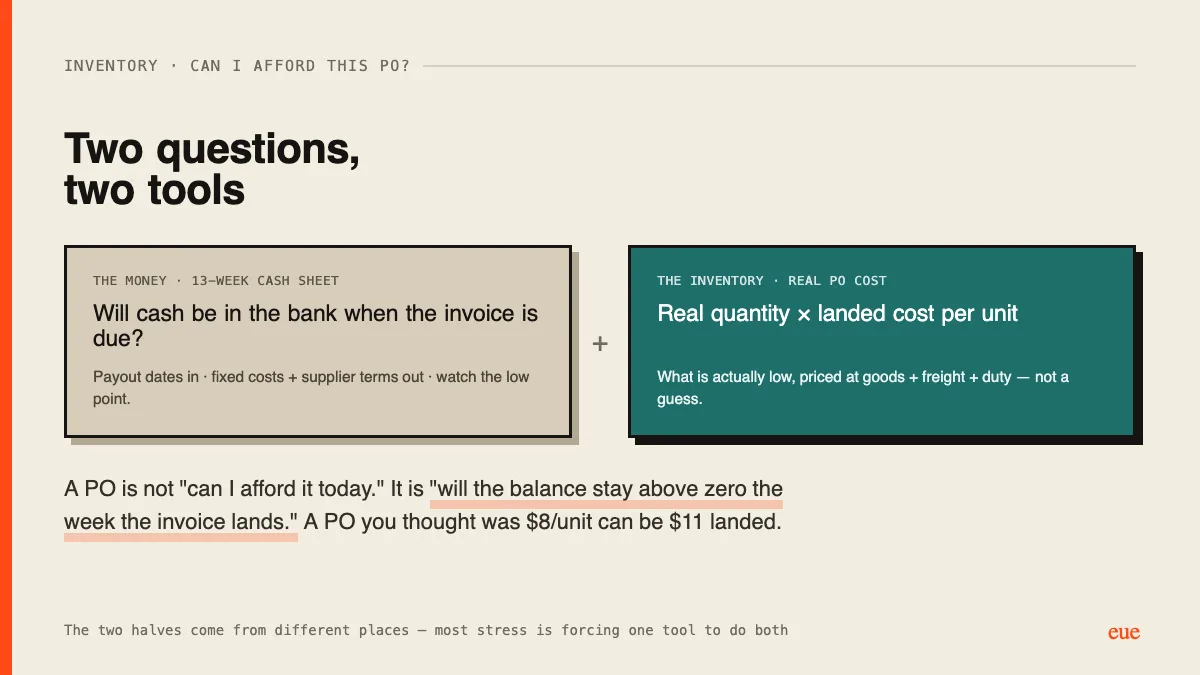
Half one: the money
Will cash actually be in the bank when the supplier invoice is due. A rolling 13-week cash-flow sheet does more than any accounting tool for this. One row per week: cash in (your Shopify payout dates, not order dates), cash out (fixed costs + supplier payment dates on real terms), and a running balance carried forward from today's bank balance. What you are looking for is the low point. A PO isn't "can I afford it today," it is "will the balance stay above zero the week the invoice lands."
Half two: the inventory
Two numbers make the PO cost real: quantity (driven by what is actually low, days of stock vs lead time), and landed cost per unit (goods + freight + duty, not the bare invoice). A PO you thought was $8/unit can be $11 landed, and that gap is exactly what wrecks the cash plan. Multiply real quantity by landed cost and you have the actual number to drop into the cash sheet instead of a guess that is off by 30%.
Are you keeping the cash sheet and the inventory list as two separate things, or have you found something that ties them together? Every setup I have seen splits them.
Keep mine split on purpose.
Cash sheet sits with payroll and ad spend. Reorder math lives on the inventory side.
One cell links them: committed on open POs. So I never forget a deposit I already promised.
Tried merging them once. More sync work than it saved.