A question that comes up a lot: how do you know your real cost per unit when you buy the same product at different prices? It matters because your margin is only as accurate as your cost number, and the invoice price is almost never the real cost.
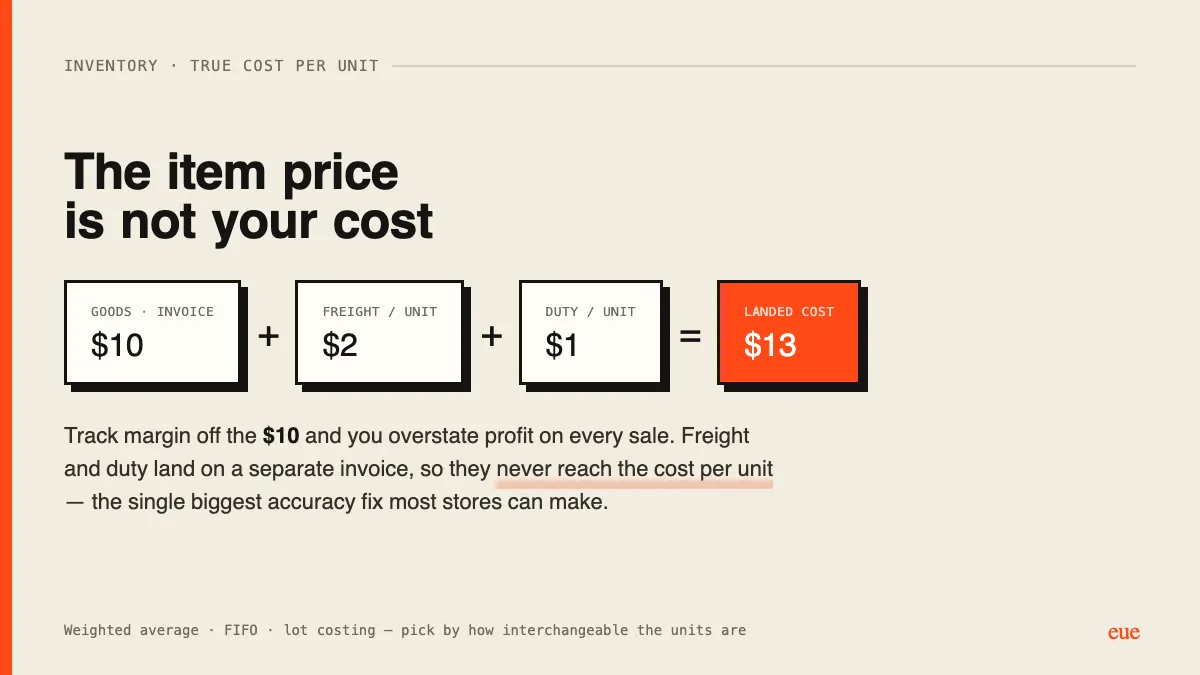
Two things people mix up: the buy price (what the supplier charged) and the landed cost (what it cost to get the unit onto your shelf, goods + inbound freight + duties + per-order fees, spread across the units). A $10 item with $3/unit of freight and duty has a landed cost of $13. Track margin off the $10 and you overstate profit on every sale. Freight and duty get left out because they land on a separate invoice, so they never make it into the cost per unit.
Valuing units bought at different prices
- Weighted average, blend all buys into one cost per SKU. Bought 100 at $8 and 100 at $12, cost is $10 going forward. Simple, stable, good enough for most repeatable catalogs.
- FIFO, the next unit sold is costed at your oldest remaining stock. More accurate when prices move a lot and it is what accountants usually want, but you track cost by receipt batch, not just by SKU.
- Specific / lot costing, every item carries its own cost. You need this for genuinely one-of-a-kind inventory (vintage, used, graded collectibles), and it generally needs a tool built for lot or serialized tracking.
On a repeatable catalog where units are interchangeable, you rarely need full lot tracking. What you need is landed cost per unit plus a sensible average that updates as you buy.
For those of you on non-identical "same SKU" inventory, are you running true per-lot costing or just eating the averaging? Where does averaging stop being good enough for you?
Comes down to variance for me, not the price.
A SKU that swings more than ~15% buy to buy goes on FIFO. The blend hides real margin problems otherwise.
Steady stuff stays weighted average. Not worth the batch tracking.