Inventory advice online mostly assumes you have 50 products. Past a few thousand SKUs the advice changes, because the failure mode changes. You can't eyeball anything, and tools that felt fine at 200 products start timing out.
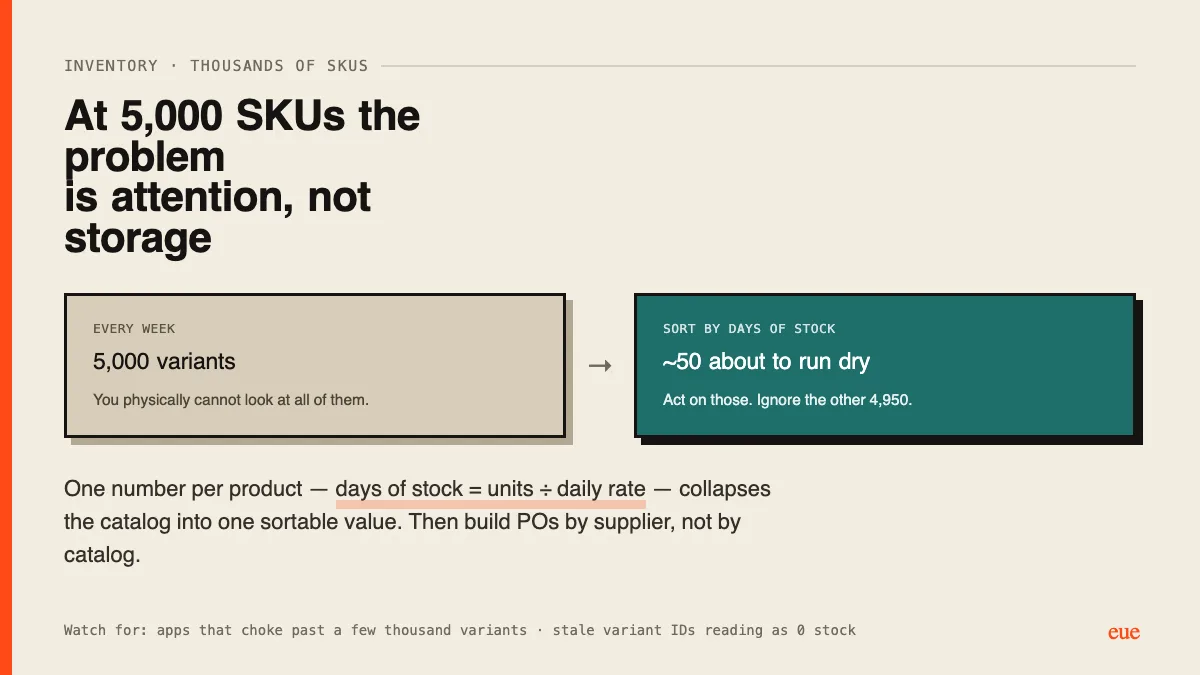
Your core problem isn't storage, it's attention. With 5,000 variants you physically cannot look at every product every week, the job is surfacing the 50 that need action today and ignoring the other 4,950. Three things make that work:
- One number per product, computed for you. Days of stock (units ÷ daily rate) collapses "how is this SKU doing" into a single sortable number. Sort the whole catalog by it and the ones about to run dry float up. That one sort replaces staring at a 5,000-row sheet.
- Reorder points from velocity, not a flat rule. A product selling 50/day and one selling 1/week need completely different triggers.
- POs built by supplier, not by catalog. At this size no one hand-picks line items.
A few things that quietly break at scale, so ask about them: does the app actually load your full catalog or choke past a few thousand variants; are stale variant links handled (delete and recreate a product in Shopify and it gets a new ID, and a lot of tools then show that SKU as zero stock forever); and can it bulk import, because typing suppliers and costs by hand is a non-starter.
If you are running a few thousand SKUs, how are you deciding what to reorder each week without checking every product by hand?
Stale variant IDs got me. Almost missed it.
A few SKUs read zero for weeks because I'd deleted and recreated the products in Shopify. At 5,000 variants they vanish.
Now I check the 0-stock list against the actual shelf once a month. Caught two more since.